Access to Justice, Access to Safety: Ending Violence Against Women and Girls
Gender-based violence (GBV) remains one of the most pervasive and widespread human rights violations globally. It affects one in three women – a number that is not only alarmingly high but has remained largely unchanged for years, and underscores the importance of investing in evidence-based prevention.
The 70th session of the Commission on the Status of Women (CSW70) takes place this week amid a rapid rollback of rights and backsliding on gender equality globally. At a time when gender equality is increasingly treated as contested terrain rather than a fundamental and inalienable human right, feminists and gender equality advocates continue to hold the line and push us forward – incrementally, defiantly – toward a gender-just future.
The theme of CSW70 – on strengthening access to justice – feels especially urgent following the release of the Epstein files which exposed deep structural faults in justice systems around the world – systems that fail survivors and normalise violence against women and girls.
Against this background, CSW70 provides an opportunity to not only strengthen access to justice, but reinforce human rights, gender equality, and efforts to end gender-based violence (GBV).
As governments, advocates, and funders convene at CWS70, this will be a critical conversation with the first High Level Meeting on Ending Violence Against Women and Girls taking place. The moment demands renewed commitment to preventing GBV and strengthening access to justice – ensuring survivors can seek safety, accountability, and live free from violence, with early signs suggesting some governments are pushing for this to be included in the Agreed Outcomes document.
This week, members from the ACT to End Violence Against Women and Girls programme will be at CSW advocating for stronger action on GBV prevention and access to justice. Drawing on recent research and global consultations with more than 150 women’s rights organisations, we will take forward urgent priorities for Member States to ensure that justice systems are effective and survivor-centred, and that feminist movements at the frontlines are resourced and protected.
“The ACT Shared Advocacy Agenda calls for bold investments in strengthening accountability, improving access to justice and ensuring the full and effective implementation of laws in the prevention and response to violence against women and girls” says Dr. Kemi DaSilva-Ibru, Co-Chairperson of the ACT Global Steering Committee.

Despite widespread legal reforms, access to justice remains deeply uneven and, in many contexts, inaccessible in practice. Comprehensive legal frameworks must be fully implemented, adequately financed, and aligned with international standards on ending GBV. This requires transformative legal reform on GBV and institutional norm change to ensure justice systems are gender-responsive and survivor-centred. Rights on paper must become protection in practice.
While strengthening legal instruments is critical, access to justice goes beyond policy and legal outcomes to encompass safety, dignity, economic independence, and freedom; it is about creating a world free from gender-based violence, where everyone is free to live to their full potential.
Justice is not only about responding to harm but stopping it from happening in the first place. As feminist activist Shamah Bulangis shared, “a survivor-centred approach does not measure justice by the number of cases resolved, but by the extent to which survivors feel heard, respected, and that accountability was delivered.” This makes the prevention of GBV one of the most powerful justice strategies available, ensuring everyone can live free from the fear of violence.
Gender-based violence impacts every part of life – from health, education, and economic security to the simple freedom to move safely through the world and participate fully in public life. As gendered violence increasingly moves into digital spaces, justice systems and technology companies must respond to the rise in technology-facilitated abuse, ensuring laws, platforms, and accountability mechanisms keep pace with the realities of digital abuse.
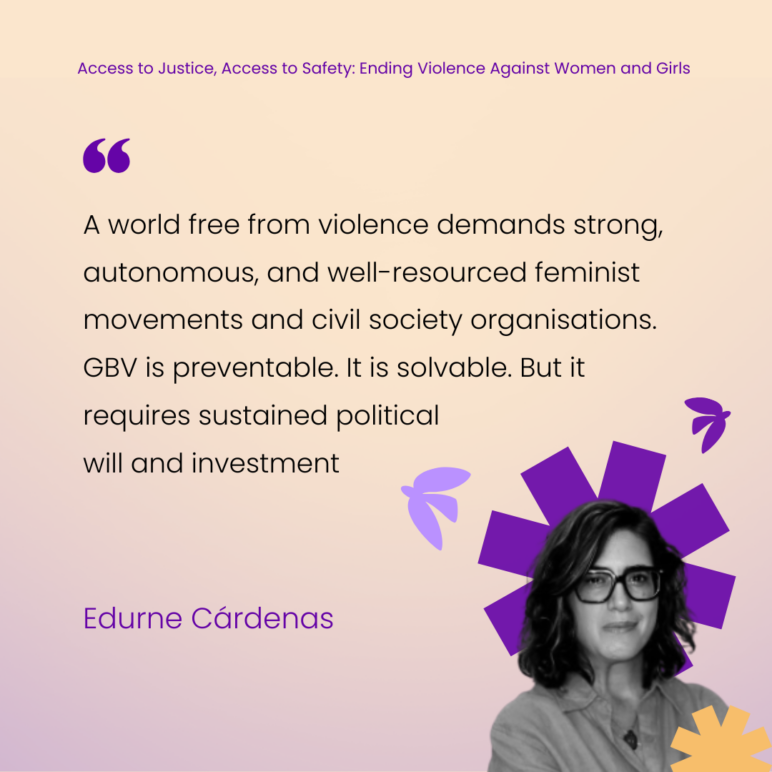
The evidence is clear – the presence of strong and autonomous women’s rights movements is the single most critical factor in reducing violence against women and girls. “For many survivors, feminist organisations are the first point of access to justice” explains feminist activist Edurne Cárdenas. WROs and feminist organisations provide legal accompaniment and psychosocial support, monitor police and court processes, track the implementation of national laws and action plans, and challenge discriminatory practices within justice systems. They also advance survivor-centred, trauma-informed responses. In many contexts, access to justice simply does not exist without feminist organisations.
Yet many of these organisations have been critically underfunded for years – a situation that has deeply worsened with recent funding cuts which directly threaten their continued existence. Recent research by UN Women and Ladysmith shows the widespread funding crisis has significantly reduced programming to end violence against women and girls. It revealed 41 percent of civil society organisations reported having to scale back essential, life-saving services or shut down entirely, and 95 percent anticipate not sustaining current operations for two years or longer.
The rollback and closure of services is already having a direct impact on the daily lives of women and girls in all their diversities. This undermines prevention, survivor support, and accountability mechanisms, all of which are essential components of access to justice. Effective and survivor-centred justice systems require feminist movements to be protected and adequately resourced as a core pillar of the justice ecosystem.
The same research undertaken through the ACT programme showed that 59 percent of respondents perceive an increase in impunity and normalisation of violence as a result of reduced civil society capacity, something we have long understood – violence thrives in silence and impunity. A weakened civil society is a sign of a weakened society.

At this moment in time, advocates are being shut out of global policy rooms. Civil society organisations and individuals have faced increasing barriers to access CSW70 – whether denied entry because of visa restrictions or fear of escalating border violence and security risks in a fraught political landscape in the US. The situation is further compounded by the introduction of visa bond requirements for certain countries, which are highly cost prohibitive. Visas denied, costs inflated, borders weaponised – civil society is being systematically shut out and silenced.
“A world free from violence demands strong, autonomous, and well-resourced feminist movements and civil society organisations. GBV is preventable. It is solvable. But it requires sustained political will and investment,” says Edurne Cárdenas.
Despite this, we are witnessing coordinated efforts to weaken the multilateral system and further shrink civic spaces. The United Nations is said to be facing an imminent financial collapse, and the global ‘rules-based order is being deliberately undone by powerful Member States weaponising under-funding as a political tool. Over 1,200 feminist organisations and allies are calling on Member States to pay up and defend multilateralism, democracy, and human rights.
As the UN carries out this system-wide reform, driven by fiscal pressures and austerity measures, there is a unique opportunity to strengthen and modernise the multilateral system – making it more accountable and fit for purpose. But there is also a real risk that these reforms will further hollow out the capacity of multilateral institutions and weaken the global gender architecture.
The warning signs are already visible. Services are closing. Prevention programmes are scaling back. These shifts are having a material impact on women and girls in all their diversity, especially across countries in the Global Majority. As Shamah Bulangis explains, “A fragile multilateral system is both a symptom and a warning sign of weakening democratic institutions. Without strong democratic intuitions, the foundations of GBV prevention begin to erode”.
While a small number of donors and networks are working to foster alignment and reinforce coordination mechanisms to ensure the funding ecosystem operates effectively and coherently, it is far from sufficient.
We have entered a new state of affairs. But feminists and gender equality advocates are accustomed to swimming upstream. As we recalibrate and adapt to the challenges of this moment – adopting new strategies and finding fresh framing to finance gender equality – we hold onto the words of Malawian feminist activist Lusungu Kalanga who shared, “global feminist leadership has never wavered. At this moment of crisis, global feminist leadership must be bolstered.” It is ultimately what will move us forward – towards progress, towards gender equality, and towards a world free from violence.
We cannot continue on with business as usual. Ultimately, CSW70 is a test – a test of our collective conviction to resist regression and the erosion of hard-fought gains.

This article was written by the ACT Strategic Advocacy and Communications Working Group, which supports a growing global movement to advocate, mobilise, and take action to end violence against women and girls in all their diversities.
ACT to End Violence Against Women is a global collective working to accelerate efforts to end all forms of violence against women through Advocacy, Coalition Building, and Transformative Feminist Action (ACT).