Ending GBV: What 2025 Taught Us & How We Organise for 2026

The past year unfolded less as a linear pathway toward progress on gender-based violence (GBV) and more as a period of shock, paralysis, recalibration, and damage control. In many spaces, energy was absorbed by crisis response and institutional uncertainty rather than a singular focus on momentum toward prevention.
Yet, 2025 was not a year without achievements. Progress surfaced in fragments: in technical negotiations, in policy language refined behind closed doors, in financing conversations that featured prevention as intersectoral, and in the steadfast resilience of feminist movements.
Efforts like ACT to End Violence Against Women, for example—calling for investments in prevention, support to women’s rights organizations (WROs), and strengthened accountability and access to justice—also helped anchor a strategic vision even in a context where visibility and accountability that historically powered feminist gains saw some momentous setbacks.
Undoubtedly GBV has been discussed in countless international, regional, national, and local fora throughout the year. In this article, we look back at some of the key moments of 2025, reflecting on what transpired in order to influence how we organize in 2026.


We start with the major achievements in 2025—a worthy celebration during a time where it felt increasingly difficult to see progress:
Taken together, the achievements of 2025 point to a year of incremental progress and strategic consolidation rather than transformation. In a global context marked by backlash against gender equality, shrinking civic space, fiscal contraction, and constrained multilateralism, the fact that the GBV agenda not only remained visible but advanced in several key ways is itself revealing.
First-time and precedent-setting gains showed us that meaningful change and policy advances are still possible even under pressure. At the same time, the recognition of femicide within G20 discussions, the focus on positive masculinity, and the growing attention to TFGBV reflect a gradual broadening of how violence is understood as not solely interpersonal.

Despite repeated reaffirmations of commitment to preventing and responding to GBV across the 2025 policy spaces, a persistent gap between rhetoric and reality remains that significantly constrains impact.
Debt distress, shrinking official development assistance (ODA), and poor-quality, short-term funding continue to weaken states’ and women’s rights organizations’ (WROs) ability to sustain prevention and survivor support. This is compounded by ongoing fragmentation: GBV work remains siloed across institutions and movements, with limited mechanisms for sustained coordination between UN processes, regional bodies, feminist actors, and economic decision-makers.
Further, civic space for WROs continues to shrink simultaneously with diminishing resources to fulfil their role at the forefront of preventing and responding to GBV.
Finally, although emerging and intersecting risks—such as TFGBV and violence in contexts of conflict, displacement, and climate crisis—are increasingly recognized, they are unevenly reflected in formal, resourced outcomes.

With these achievements and shortcomings in mind, ten key themes from 2025 emerge: 1) crisis response, 2) financing, 3) pragmatism, 4) collaboration and solidarity, 5) agility and flexibility, 6) narratives, 7) shrinking multilateralism, 8) accountability, 9) TFGBV, and 10) positive masculinities.
1) Time as strategy: crisis response vs. long-term transformation
Organizations have been forced to balance urgent survival and resistance with investment in the longer-term futures they seek to build. Many are being forced to choose between meeting immediate needs and staying true to a long-term vision. Laxman Belbase of the MenEngage Alliance poignantly asks: “Are we working for the resistance and survival of now, or for the sustained future we want to see?”
Milestones such as Beijing+30 and the UN’s 80th anniversary only heightened the visibility of the tension. Equal Measures 2030 showed that progress on gender equality has stalled or reversed in at least 40 percent of countries, overshadowing these moments of celebration.
Yet in a time when visionary thinking is needed, short-term survival—amid backlash, conflict, funding cuts, and shrinking civic space—often dominated political negotiations and longer-term investments struggled to gain traction. The launch of ALL IN articulates this dilemma directly, positioning itself as an effort to move beyond reactive cycles toward sustained systems change, even while acknowledging that it is “already late”, says Belbase.
2) Financing as a battleground: debt, austerity, and reprioritization
Financing emerged as the most consistent battleground across the year, particularly in Financing for Development Forum, the Financing for Feminist Futures Forum, HLPF, and G20 Empowerment of Women Working Group (EWWG) discussions.
Debt, austerity, declining ODA, and militarization are forces hollowing out states’ capacity to fund social services including GBV prevention and response. An estimated 3.4 billion people now live in countries that spend more on servicing debt than on health or education, severely constraining governments’ ability to invest in social protection, survivor services, and prevention. Bettina Baldeschi, Executive Director of The Accelerator for Gender Based Violence Prevention, captured the stakes succinctly: “If more is being spent on servicing debt rather than social protection, what does that mean to GBV prevention and response?”.
At FfD4, GBV was marginal—appearing only once in the outcome document, the Sevilla Commitment, and in just one side event—despite the wider recognition of a global crisis. Furthermore, GBV was not identified within the Sevilla Platform for Action (SPA), the set of more than 130 voluntary initiatives aimed at putting the Sevilla Commitment into practice. This may be reflective of a lack of dedicated resources for such initiatives. For instance, the European Union (EU) quietly shifted resources away from issues such as GBV prevention on humanitarian and development priority lists. UN Women reported in late 2025 that only a small fraction of WROs working to end GBV (five percent) have the financial stability to continue operating over the next two years, and roughly 40 percent are being forced to scale back or suspend critical services.
Maria Malomalo of Restless Development and the Walking the Talk Consortium explained: “We have seen that resources that were intended for feminist movements and women’s rights have increasingly been channeled towards other issues such as wars and military spending […] GBV prevention is not simply underfunded—it is structurally underprioritized by current financing models.”
Financing Feminist Futures further underscored the unsustainability of relying on ODA alone and encouraged looking into the role of community-led budgeting processes, community and international philanthropy, and private capital as potential sources of support, though they require accountability and feminist reorientation.

3) Pragmatism under constraint: focusing on what works in practice
Pragmatism has emerged as a negotiation reality in 2025. Consistently, outcomes have been preserved but diluted. For example, CSW’s Political Declaration underwent a months-long negotiation process to accommodate opposition, including prominently by the United States. To reach consensus some areas—such as bodily rights, inclusion policies, and comprehensive sexual and reproductive health and rights (SRHR)—received limited attention in the final negotiated texts, reflecting ongoing political tensions within multilateral processes.
At the United Nations General Assembly (UNGA), there was a similar shift toward what is politically feasible rather than what is aspirational, resulting in the consolidation of existing GBV frameworks rather than their expansion.
Also, at HLPF, pragmatism manifested in an emphasis on national-level tools such as gender-responsive budgeting, mandatory gender analysis, and institutionalized gender mainstreaming highlighted through Voluntary National Reviews. While this focus grounded GBV in concrete policy levers, it also came with trade-offs, as noted by Foteini Papagioti of the International Center for Research on Women (ICRW) and Women’s Major Group (WMG): consensus is becoming “increasingly more elusive and potentially a constraint, if gender equality and GBV champions are forced to make more trade-offs.” Pragmatism thus enabled survival and partial progress, while simultaneously limiting ambition.
4) Silos to sharing: toward collaboration, coordination, and solidarity
Fragmentation has consistently been a core weakness of GBV efforts, making collaboration and solidarity both a theme and a response in a time of growing backlash. This is articulated most clearly through the launch of ALL IN, which explicitly positions itself as a corrective to a field in which “GBV, as an area of politics, has been fragmented […] doing our own work in isolation,” as noted by Laxman Belbase of the MenEngage Alliance.
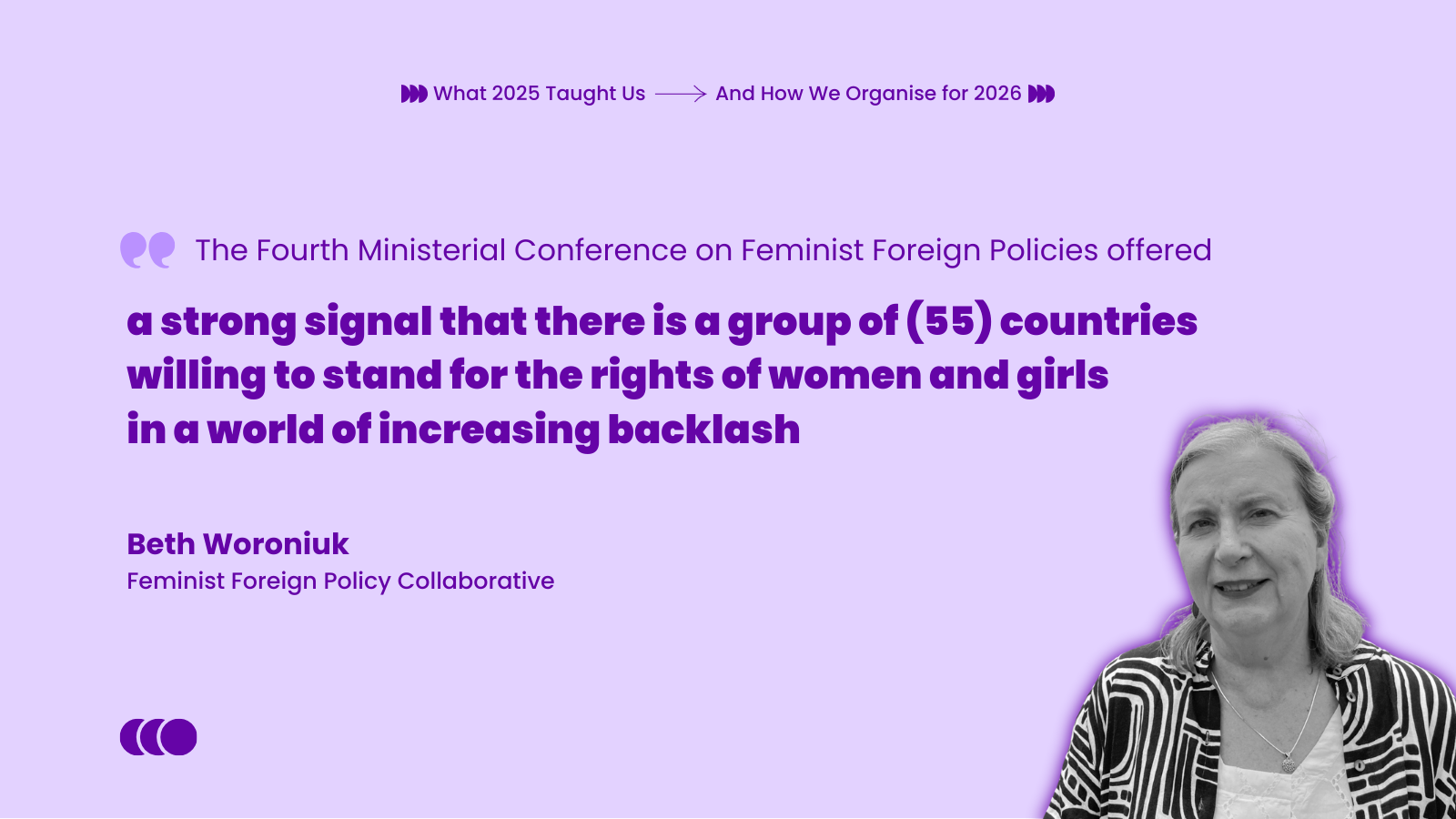
The Fourth Ministerial Conference on Feminist Foreign Policies similarly functioned as a space of political solidarity outside formal UN negotiations, offering “a strong signal that there is a group of (55) countries willing to stand for the rights of women and girls in a world of increasing backlash,” shared Beth Woroniuk of the Feminist Foreign Policy Collaborative.
Elsewhere, collaboration appeared more uneven: while HLPF convened diverse actors across government and civil society, it lacked mechanisms to translate coordination into accountability; and in FfD4, GBV advocates remained largely disconnected from core economic and financing discussions, reinforcing long-standing siloes between feminist movements and macroeconomic decision-making.
Taken together, 2025 saw meaningful progress in building coalitions, but also revealed the limits of current cross-sectoral collaboration.

5) Agility and flexibility: adapting to meet the moment
Agility and flexibility are strategic necessities rather than optional traits. Movement-led and hybrid spaces such as ALL IN, 16 Days of Activism, and Financing Feminist Futures were able to be more adaptive than formal intergovernmental processes. These platforms were able to engage new constituencies, interrogate power and financing models, and recalibrate strategy in real time.
By contrast, formal negotiations at CSW69, HLPF, and FfD4 were consistently constrained by consensus rules, pushback against gender equality language, and lengthy timelines that struggled to keep pace with rapidly evolving forms of violence. Financing Feminist Futures, in particular, stood in sharp contrast to FfD4: while the latter largely sidelined GBV and feminist financing priorities, the former created an agile, movement-led space to question short-term and extractive funding models and articulate what sustained, accountable financing for prevention requires.
ALL IN similarly reflects this adaptive turn, having been established precisely because “existing structures were not moving fast enough to meet the scale of the problem,” according to Belbase. The reliance on such adaptive tactics underscores a broader lesson from the year: when institutional pathways narrow and risks escalate, flexibility becomes essential to sustaining momentum and positioning movements to seize future openings.
6) The battle of narratives: backlash, dilution, and the fight over “gender”
Narratives were actively contested across nearly all spaces in 2025. As UN Secretary-General António Guterres warned at CSW69: the “poison of patriarchy is back with a vengeance,” underscoring how narrative struggle is inseparable from political struggle. We are in a battle not only over policy but over the frame, purpose, and importance of gender equality work.
At CSW69, language around GBV, SRHR, and inclusion was heavily negotiated, resulting in what many described as a “significantly watered down” Political Declaration.
At UNGA, similar dynamics played out, with emerging issues such as TFGBV often excluded despite acknowledgment in debates. Also, civil society experienced repression and constraints on their access and expression (including censorship), and critiqued instrumentalization of gender equality “for economic gain.”
Anti-gender movements and opposition to rights are increasingly reframing gender equality as a cultural or political threat rather than an urgent human rights issue, undermining the perceived urgency of GBV prevention.
A 2025 report by Equality Now about the backlash against women’s and girls’ rights notes that loss of gender-inclusive language threatens to weaken international standards and erode accountability for GBV, reflecting a shift toward narratives that sideline GBV commitments rather than treat them as imperative.
Against this backdrop, campaigns like 16 Days of Activism and initiatives like ALL IN sought to reassert GBV as cross-sectoral, urgent, and preventable, challenging narratives that frame violence as inevitable or secondary.

7) Multilateralism under strain: shrinking inclusion, expanding side doors
Twenty twenty-five was a confusing year for multilateralism as it was widely considered to have survived, but also visibly narrow and became more exclusive and restrictive.
For instance, during FfD4 there was heavy “censoring of spaces,” security restrictions, and civil society repression. The United States’ withdrawal from FfD4 intensified debate over the future of multilateralism. While UN leadership framed the agreement as evidence that “the show goes on,” many Majority World governments and feminist actors noted that the commitment largely upheld the status quo. But in the end, the claim that “multilateralism is at breaking point but survived” resounded, according to Baldeschi.
As formal UN processes became more constrained with financial shortfalls and reform became an inevitability, political momentum increasingly shifted to “side-door” venues such as the G20 EWWG, ALL IN, Financing Feminist Futures, the Feminist Foreign Policy Ministerial Conference, and the 16 Days of Activism campaign. These parallel spaces enabled stronger positioning, coalition-building, and experimentation around GBV prevention that proved difficult to advance through consensus-bound negotiations.
These side doors did not replace multilateralism, but they increasingly compensated for its limitations. And even within the formal UN processes and parallel spaces, “closed door” meetings and events became more common. There, actors operated within smaller circles; while understood as a means of protection for progress to not be sidelined by actors pushing for regressive policies or narratives, this also symbolized a retraction of feminist gains by narrowing accountability and movement participation.
8) The accountability deficit: commitments without enforceable follow-through
Across the 2025 processes, a persistent gap was the lack of enforceable mechanisms to translate GBV commitments into action. This was evident across CSW69, HLPF, FfD4, G20 discussions, and even the otherwise historic AU Convention on Ending Violence Against Women and Girls.
The HLPF was explicitly framed as a space for learning and exchange rather than accountability, with “no meaningful, enforceable follow-through for any proclaimed commitments,” as explained by Papagioti.
Similarly, UN and G20 commitments relied largely on voluntary action and national discretion rather than binding obligations. Feminist critiques acknowledge the historic milestone of the AU Convention on Ending Violence Against Women and Girls, but warn that its impact is weakened by how it was developed.
Women’s rights organizations were largely left out of the process, raising concerns about legitimacy, and the Convention relies heavily on state discretion for implementation, with few meaningful accountability mechanisms to ensure real change.
9) Technology-facilitated GBV: recognition growing on the scene
As the Nobel Peace Prize winner, Maria Ressa, underscored at UNGA80, “as has been proven time and time again, online violence is real world violence.” TFGBV surfaced as a growing concern across CSW69, UNGA80 resolutions, G20 EWWG, and 16 Days of Activism. For instance, the G20 EWWG Chair’s Statement commits to addressing GBV “amplified by […] technology-facilitated” abuse, explicitly naming forms such as stalking, harassment, and non-consensual sharing of manipulated material.
The AU Convention also noted online harassment as an emerging form of violence to address. The issue gained more visibility through evidence and advocacy. The 16 Days campaign centered the theme in 2025 (#NoExcuse), highlighting how online abuse translates into real-world harm, particularly for women human rights defenders and journalists.
Artificial intelligence (AI) poses a particular threat to TFGBV because it supercharges scale, speed, and anonymity. The 16 Days campaign highlighted how AI and other digital tools are dramatically amplifying TFGBV, enabling harmful practices such as deepfake pornography, algorithmically driven harassment, automated hate speech, and coordinated digital attacks that disproportionately target women. However, TFGBV illustrates the limits of consensus.
While acknowledged, accountability for the technology sector remains weak, with few binding standards or safeguards in place. But in 2025, a violence against women migrant workers resolution was introduced during UNGA80 that explicitly flagged the growing role of AI in enabling exploitation, noting that traffickers are increasingly using AI tools to “profile, recruit, control and exploit” women migrant workers.
The need for rights-centered action—including stronger platform accountability, digital literacy, safeguards for survivors, and legal protection—to counter these emerging forms of abuse is urgent. UN Women culminated the 16 Days campaign by announcing a new rights-based framework to address these risks.
10) Positive masculinity: the engagement of men and boys
Positive masculinity emerged as a notable theme at ALL IN, HLPF, the AU Convention on Ending Violence against Women and Girls, and the G20 EWWG, signaling a shift in how prevention is conceptualized. Rather than treating men solely as perpetrators or bystanders, these spaces increasingly frame masculinities as a root cause that must be addressed through accountability, norm change, and engagement. The G20 EWWG is explicit that engagement of men and boys was a vital aspect, and a dedicated ministerial side event on positive masculinity was hosted, which helped pave the way for the AU Convention on Ending Violence Against Women and Girls.
HLPF materials also reference engaging men and boys in preventing Sexual and Gender-Based Violence physically and digitally as part of an integrated SDG approach.
Work on masculinities and prevention has been consistently under-resourced, despite decades of evidence that violence is preventable, and must be expanded in ways that strengthen—rather than redirect resources away from—WROs and feminist movements. To correct this, ALL IN frames masculinities and patriarchy as root causes of GBV and emphasizes holding men accountable not only for perpetrating but witnessing violence and failing to intervene. Belbase describes: “Engaging men is not about being ‘nice’ allies; it is about accountability for power, privilege, and silence.”


This year will likely be defined by strategic urgency. Early signals—from evolving global security priorities to institutional restructuring within the UN system—suggest that political space may tighten further, not widen. Backlash against gender equality, fiscal contraction, and constrained multilateralism are no longer temporary headwinds but structural conditions shaping the terrain ahead.
Against this backdrop, prevention-centered, coordinated feminist advocacy is not optional; it is existential. The global collective ACT to End Violence Against Women is taking this call seriously in its Shared Global Advocacy Agenda. The convergence of Beijing+30 with shrinking aid, rising debt burdens, and growing resistance to rights-based language sharpens a central challenge for the field: how to sustain and scale GBV prevention when traditional policy pathways are narrowing and implementation gaps continue to widen. What 2025 made clear is that the path forward will rely less on singular breakthroughs in formal negotiations and more on coalitions, adaptive platforms, reaching out to non-traditional funders and supporters, and deliberate “side-door” strategies.
Last year clarified several strategic imperatives for 2026:
The core questions ahead are not whether progress is possible, but how it is organized: how accountability is maintained as negotiations move behind closed doors; how prevention remains central when crises dominate agendas; and how gains are made to compound rather than dissipate. Framed this way, 2026 is not a reset but a test of whether the hard-fought gains of 2025 can translate into more durable power, resources, and accountability to end GBV within years, not lifetimes.
Acknowledgements
This article was researched and written by Katie Whipkey. Thank you to the individuals who generously contributed their time, expertise, and perspectives to shape this piece – Laxman Belbase, Maria Malomalo, Foteini Papagioti, and Beth Woroniuk.